Front End Steering Rebuild Kits
Package kits bundle the wearing steering parts and ball joints for this truck.

This interactive diagram shows the front suspension, steering, driveline and rear suspension of the 2002 Dodge Durango with four wheel drive. Hover over or tap any part to see what it does, the signs that it is worn, and the replacement parts we carry that fit your Durango, down to the side and position.
We carry parts for it Not stocked yet Hover or tap any part.
The four wheel drive Durango of these years has an independent front suspension sprung by torsion bars: each bar runs back from the lower control arm to an adjustable key in a crossmember under the floor. A frame mounted front differential drives the front wheels through two CV shafts, and a rack and pinion sits ahead of the front wheels, behind the sway bar. The rear is a solid axle on leaf springs, with a rear sway bar and drum brakes on the truck drawn here.
We carry replacement parts for 24 of the 42 components on this diagram, 81 parts in all. See every part for the 2002 Dodge Durango 4WD.
Package kits bundle the wearing steering parts and ball joints for this truck.
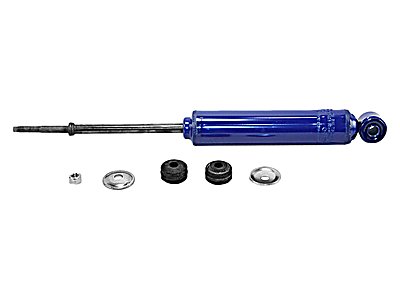
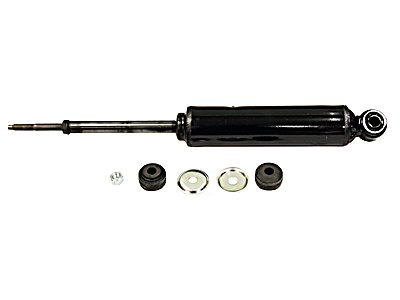
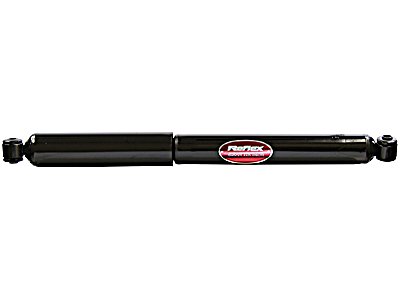
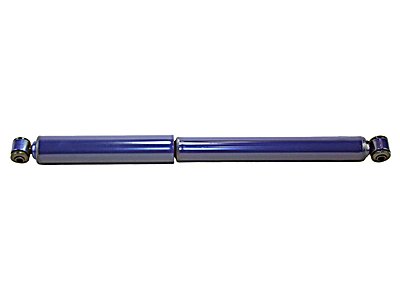
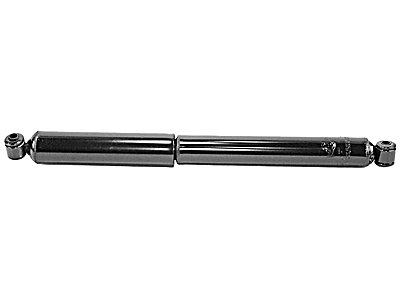
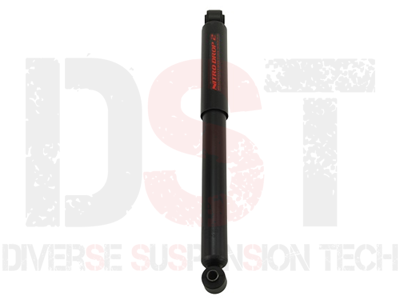
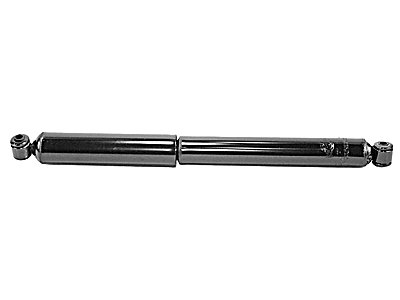
Front and rear shock sets for the whole truck.
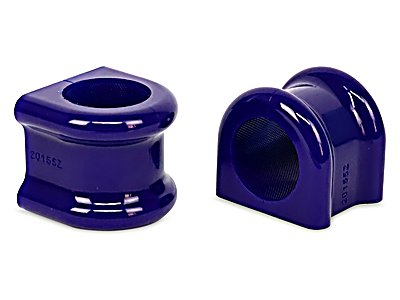
One kit with the suspension bushings and bump stops for the whole truck.
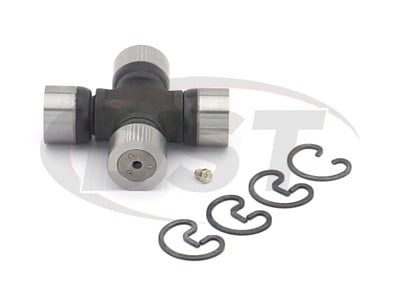
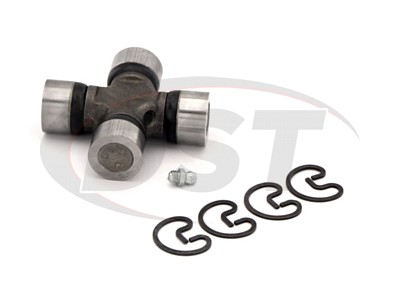
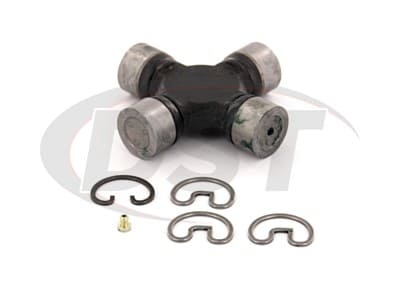
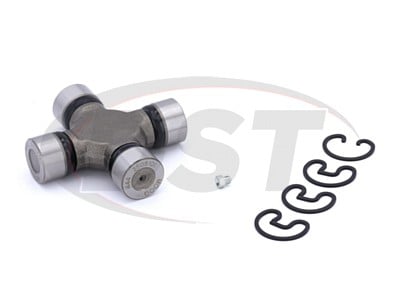
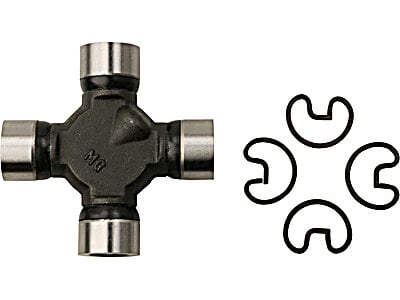
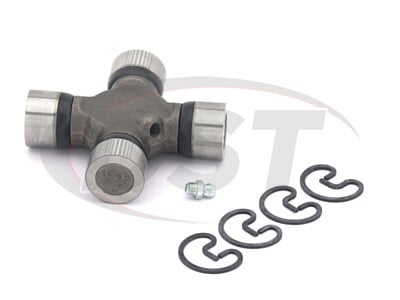
Every U-joint for the truck in one order. Check the engine and driveshaft notes on each package.
The lower ball joint presses into the outer end of the lower control arm. Its stud points up into the bottom of the steering knuckle.
Signs of wear: A clunk or knock over bumps, a shimmy, or play at the bottom of the tire with the front lifted.
Tip: The torsion bar loads the lower arm, so unload the bar and support the arm before the joint is separated.
See all Front Lower Ball Joint parts for the 2002 Dodge Durango 4WD
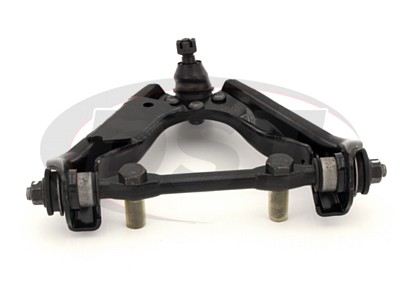
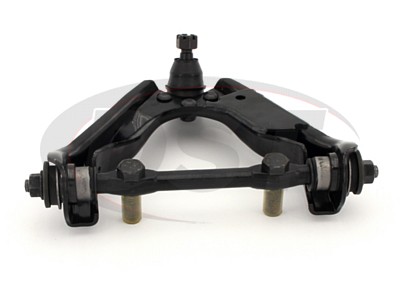
A stamped steel A-arm on two rubber bushings. The bushings ride on a cross shaft that bolts to a bracket on the frame with two studs. The upper ball joint is riveted into the outer end and its stud goes down into the knuckle.
Signs of wear: Clunks, torn or cracked bushings, or a worn ball joint at the outer end.
Tip: The complete arm comes with a new ball joint and bushings. Get a front alignment after replacing it.
See all Front Control Arm parts for the 2002 Dodge Durango 4WD
The upper ball joint is riveted into the outer end of the upper control arm at the factory. Replacement joints bolt in where the rivets were. Its stud points down into the top of the steering knuckle.
Signs of wear: Wandering, a clunk over bumps, uneven tire wear, or play when the tire is rocked top to bottom with the front lifted.
Tip: These upper joints were recalled on 2000 to 2003 4x4 trucks built through December 2002 (recall 04V596, Chrysler D47): water could get in. The rivets are ground and punched out and the new joint is bolted in.
See all Front Upper Ball Joint parts for the 2002 Dodge Durango 4WD
A cast A-arm. Its front and rear eyes pivot on bolts in frame brackets, and its rear pivot takes the torsion bar. The shock passes through a pocket in the middle of the arm, and the lower ball joint presses into its outer end.
Signs of wear: Clunks, a shimmy after bumps, torn bushings, or a worn lower ball joint.
Tip: Unload the torsion bar with the right tool before taking the arm off: the bar holds the truck up. Left and right arms are different parts.

See all Front Control Arm parts for the 2002 Dodge Durango 4WD
Rubber bushings in the two inner eyes of the upper arm, where it pivots on the frame bracket.
Signs of wear: Clunks over bumps, alignment that won't hold, or cracked rubber.
Tip: Press the old bushings out of the arm and the new ones in; aftermarket urethane kits replace them in pairs.
See all Front Control Arm Bushings parts for the 2002 Dodge Durango 4WD
Rubber bushings in the front and rear eyes of the lower control arm.
Signs of wear: Clunks when braking or over bumps, or the tire moving fore and aft.
Tip: Unload the torsion bar before removing the arm. Urethane kits replace the bushings in pairs.
See all Front Control Arm Bushings parts for the 2002 Dodge Durango 4WD
The cast knuckle (spindle) turns between the upper and lower ball joints. It carries the hub bearing, the brake caliper and the steering arm for the outer tie rod end.
Signs of wear: Rarely wears out. Replace it after damage, or if a tapered ball joint or tie rod hole is worn.
The front spring. A steel bar runs back from the lower control arm to a key in a crossmember under the floor. Twisting it holds the front of the truck up.
Signs of wear: Front ride height that sags and cannot be corrected at the adjuster.
Tip: The bars are under heavy load. Measure the adjuster bolts before any work and unload the bars with a torsion bar tool.
The key sits on the rear hex of each torsion bar in the crossmember. An adjuster bolt pushes on its tail and sets the front ride height.
Signs of wear: Front end sits low or uneven, the adjuster bolt is seized or at the end of its travel.
Tip: Leveling keys raise the front by clocking the bar. Expect a front alignment afterwards, and do not crank the front so high that the CV shafts run at a steep angle.
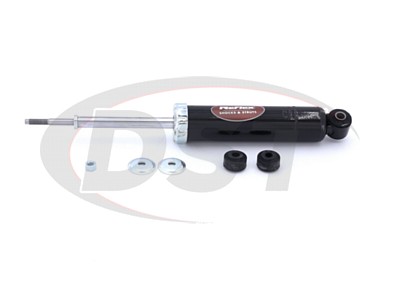
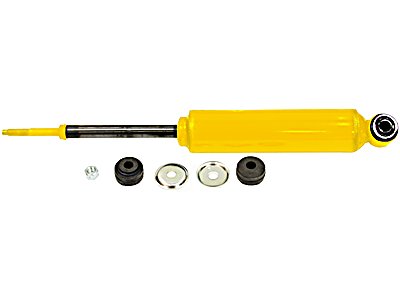
The front shock bolts by its lower eye in the lower control arm and runs up past the upper arm to a stem mount in a frame bracket.
Signs of wear: Bouncing after bumps, nose dive under braking, or a leaking shock.
Tip: Leveled trucks may need longer shocks; check the listing for the lift height it suits.
See all Front Shock Absorber parts for the 2002 Dodge Durango 4WD
A rubber bump stop in a cup on the frame, over the lower control arm. It cushions the arm at the end of its travel.
Not on every vehicle: Not drawn: no bump stop part is listed or sold for these trucks, and no photo shows where it sits.
Signs of wear: A harsh bang when the front bottoms out, or a missing or crumbled stop.
Tip: The stop presses into its cup. Leveling and lift kits often add a spacer under it.
The bar runs across the very front of the truck in two bushings under the frame. Its ends reach back to the lower control arms, where each is clamped in a bushing on top of the arm.
Signs of wear: Body roll in turns. The bar itself rarely fails; listen for its bushings and links first.
Tip: Two bar sizes are listed for these trucks: the drawing shows the 1.40 inch (36 mm) bar, and some trucks have a 1.30 inch (33 mm) bar. Measure the bar before ordering bushings.
Two rubber bushings in straps hold the bar to the frame, and a bushing in a two bolt clamp holds each bar end on top of the lower control arm.
Signs of wear: Squeaks or clunks over bumps and in turns.
Tip: Bushings are sold by bar diameter. Most of these trucks use a 1.40 inch (36 mm) bar and some a 1.30 inch (33 mm) bar: measure the bar or check the listing.
See all Front Sway Bar Bushings parts for the 2002 Dodge Durango 4WD
Listed here, not drawn: link bushing kits for trucks with front sway bar links.
Not on every vehicle: Not drawn: on the truck photographed (NHTSA test 3642, a 2001 Durango 4x4) each front sway bar end is clamped in a bushing directly to the lower control arm, with no link. Link bushings (K7320) are also listed; if your truck has links, they fit here.
Signs of wear: Rattles or clunks over small bumps, or a broken link.
Listed here, not drawn: cam bolt and caster/camber kits that replace the plain control arm pivot bolts so a shop can set camber and caster.
Not on every vehicle: An aftermarket correction part. The diagram shows the factory plain pivot bolts.
Signs of wear: Uneven tire wear, or an alignment that is out of range after a lift, leveling kit or a hard hit.
Tip: The factory pivot bolts are plain; these kits add adjustment, usually about plus or minus 1 to 2 degrees.
The inner tie rod screws onto the end of the steering rack inside the rubber boot. The rack sits ahead of the front axle line, behind the sway bar.
Signs of wear: Wandering, loose steering, or a clunk when turning the wheel back and forth. Check by squeezing the boot while someone turns the wheel.
Tip: Replace the boot at the same time, and set the toe with an alignment afterwards.
See all Front Inner Tie Rod End parts for the 2002 Dodge Durango 4WD
The outer tie rod end threads onto the inner tie rod and its stud goes into the steering arm at the front of the knuckle.
Signs of wear: Loose or wandering steering, uneven inner or outer tire wear, or a torn boot.
Tip: Count the turns when you remove it, so the toe stays close until the alignment.
See all Front Outer Tie Rod End parts for the 2002 Dodge Durango 4WD
Rubber bushings in the two mounting clamps of the rack and pinion, where it bolts to the front crossmember.
Signs of wear: The steering wheel turns a little before the wheels respond, or a clunk when turning.
Tip: Only move the rack forward enough to press out the old bushings.
See all Steering Rack Bushings parts for the 2002 Dodge Durango 4WD
A CV shaft on each side runs from the frame mounted front differential to the hub, with a plunging joint at the differential and a fixed joint in the knuckle. The differential sits on the driver side, so the passenger shaft runs from the end of the axle tube.
Signs of wear: Clicking when turning in four wheel drive, grease thrown from a torn boot, or a vibration.
Tip: Torn boots let grease out and grit in. Replace the shaft when a joint clicks on tight turns.
The U-joint at the front of the front driveshaft, bolted to the front differential's input flange.
Signs of wear: Clunks when shifting into four wheel drive, or a vibration in four wheel drive.
The rear driveshaft. The truck drawn has a one piece shaft with two joints; some trucks have a two piece shaft with a center bearing.
Signs of wear: Vibration on takeoff or at speed.
The front U-joint of the rear driveshaft, at the transmission.
Signs of wear: A clunk when shifting into gear, or vibration.
The middle U-joint, just behind the center support bearing, on trucks with the three joint shaft.
Not on every vehicle: Only on trucks with a two piece rear driveshaft (center bearings are listed for 2000 and 2001). The truck drawn has a one piece shaft.
Signs of wear: Vibration that comes and goes with load.
The U-joint at the rear differential end of the rear driveshaft.
Signs of wear: A clunk on takeoff, a squeak, or rust dust around the caps.
Tip: Check the fit notes: the joint size depends on the axle and transmission.
Holds the middle of the two piece rear driveshaft to a crossmember.
Not on every vehicle: Only on trucks with a two piece rear driveshaft (center bearings are listed for 2000 and 2001). The truck drawn has a one piece shaft.
Signs of wear: A rumble or vibration at speed, or a torn rubber mount.
The solid rear axle on leaf springs. Trucks have either an 8.25 inch or a 9.25 inch ring gear axle, depending on engine; the shape is much the same.
Signs of wear: Leaks at the cover or axle seals, or gear whine.
A five leaf spring each side under the frame rail, clamped to the axle with U-bolts. The front eye bolts to a fixed hanger and the rear eye to a shackle.
Signs of wear: A sagging rear, a broken leaf, or a spring that has shifted on the axle.
Bushings in the spring eyes at the front hanger and the rear shackle.
Signs of wear: Squeaks over bumps, clunks on takeoff, or rubber pushed out of the eye.
See all Rear Leaf Spring Bushings parts for the 2002 Dodge Durango 4WD
The link at the rear of each spring that lets the spring grow longer as it flexes.
Signs of wear: Squeaks, a clunk, or a worn or cracked shackle.
Two U-bolts each side clamp the spring to the axle perch with a plate underneath.
Signs of wear: A spring that has shifted on the axle, or loose U-bolt nuts.
Tip: Use new U-bolts and nuts when the spring is removed.
Both rear shocks mount behind the axle and lean back to the frame.
Signs of wear: Bouncing, a rear that squats or floats, or leaks.
See all Rear Shock Absorber parts for the 2002 Dodge Durango 4WD
A rubber stop on a bracket under each frame rail, above the leaf spring.
Signs of wear: A hard bang when loaded, or a torn or missing stop.
Tip: Check the fit notes on each listing.
A rear sway bar behind the axle, clamped to it in two bushings, with links up to the frame rails.
Tip: Rear bars differ between trucks: the drawing shows an 18 mm bar, and 20 mm bushings are also listed. Measure the bar before ordering bushings.
Each link ties a bar end to a bracket on the frame rail.
See all Rear Sway Bar Endlinks parts for the 2002 Dodge Durango 4WD
Two bushings hold the rear bar to brackets on the axle.
Tip: Bar sizes differ between trucks (18 and 20 mm bushings are both listed): measure the bar or check the listing.
See all Rear Sway Bar Bushings parts for the 2002 Dodge Durango 4WD
A sealed bearing and hub unit bolted to the knuckle with three bolts, with six wheel studs. The CV shaft's splined stub runs through it and is held by the axle nut.
Signs of wear: A hum or growl that changes with speed, play in the wheel, or an ABS light.
Tip: Check whether your truck has the wheel speed sensor at the hub; the hubs are sold with and without it.
See all Front Wheel Bearing and Hub Assembly parts for the 2002 Dodge Durango 4WD
A vented 287 mm rotor that slips over the hub studs (2000 to 2002 trucks).
Signs of wear: A pulsing pedal, grooves or rust ridges, or thickness under the minimum.
See all Front Brake Rotor parts for the 2002 Dodge Durango 4WD
A one piston caliper at the back of each front rotor.
Signs of wear: Pulling while braking, a dragging wheel, leaks, or uneven pad wear.
One pad each side of the rotor, held in the caliper.
Signs of wear: Squealing, grinding, or a long pedal.
See all Front Brake Pads parts for the 2002 Dodge Durango 4WD
The drawn truck has 11 inch rear drum brakes. The drum slides over the axle studs.
Signs of wear: A pulsing pedal when stopping gently, or scoring inside the drum.
Two shoes per side on the backing plate inside the drum (11 x 2-1/4 inch). They also serve as the parking brake.
Signs of wear: A low or soft pedal, a weak parking brake, or grinding from the rear.
See all Rear Brake Shoes parts for the 2002 Dodge Durango 4WD
Pads for trucks built with rear disc brakes.
Not on every vehicle: Not drawn: the truck drawn has rear drum brakes. Rear disc pads are listed for some of these trucks; if yours has rear discs, they fit here.
Signs of wear: Squealing, grinding, or low pad material.
See all Rear Brake Pads parts for the 2002 Dodge Durango 4WD
Torsion bars. Each bar runs from the lower control arm back to a key and adjuster bolt in a crossmember. The two wheel drive Durango of these years uses coil springs instead, so its springs and lower arms do not fit.
Yes. Chrysler recall D47 (NHTSA 04V596) covers 2000 to 2003 Durango and Dakota 4x4 trucks built through December 31, 2002: water could get into the upper ball joints. The fix replaces both upper joints, which are riveted into the upper arms at the factory, with bolt-in joints.
No. The driver and passenger upper arms are different parts, and so are the lower arms. Each upper arm comes with its ball joint; the lower ball joints are also sold on their own.
The truck drawn has 11 inch rear drums. Rear disc pads are also listed for some Durangos of these years, so look through a rear wheel before ordering: a drum hides the shoes, a disc shows a caliper.
Yes. Tie rods, ball joints, control arms and torsion bar adjustments all change the alignment. Measure the torsion bar adjuster bolts before you start, so the ride height goes back where it was.
Numbered diagrams to print or save for the shop. The numbers match the numbered parts on the interactive diagram.