Strut and Shock Sets
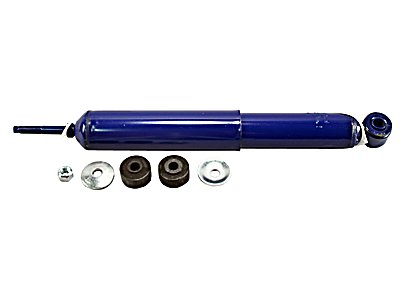
Front struts and rear shocks for the whole car in one order.
This interactive diagram shows the front suspension, steering and rear suspension of the 2002 Ford Focus sedan. Hover over or tap any part to see what it does, the signs that it is worn, and the replacement parts we carry that fit your Focus, down to the side and position.
We carry parts for it Not stocked yet Hover or tap any part.
The 2000 to 2007 Focus uses MacPherson struts at the front, with the coil spring on the strut and a stamped steel L shaped lower arm under each corner. The ball joint is held to the arm's outer end, the steering rack sits behind the front axle, and the front sway bar joins the struts through short links. The rear is Ford's Control Blade multi-link design on its own subframe: the knuckle and trailing arm are one part, a wide spring arm behind the axle carries the coil, a short link ahead of the axle sets the toe, an arched upper arm sits on top, and the shocks are separate from the springs. The diagram draws the sedan with rear drum brakes. Hatchback and wagon cars share the layout but use different rear springs, and some cars have rear discs.
We carry replacement parts for 27 of the 33 components on this diagram, 112 parts in all. See every part for the 2002 Ford Focus.
Front struts and rear shocks for the whole car in one order.
A strut with its spring, mount and boot already assembled, so no spring compressor is needed.
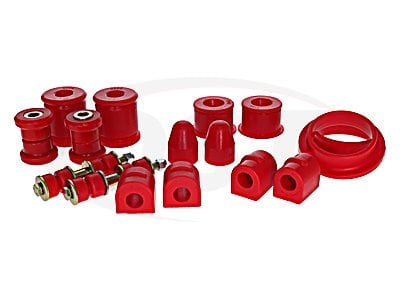
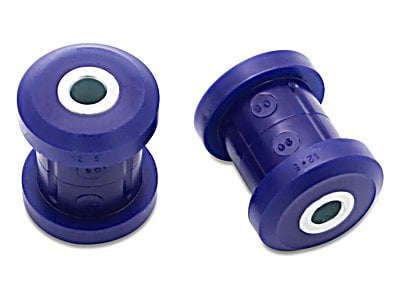
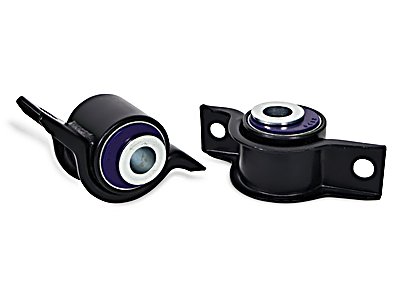
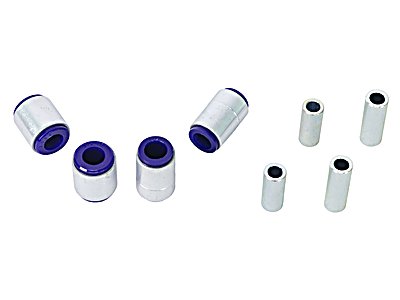
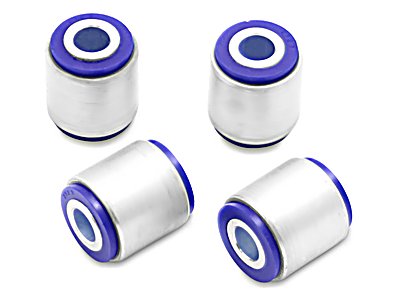
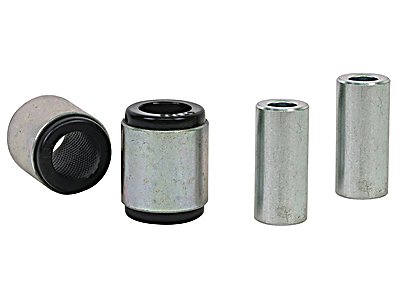
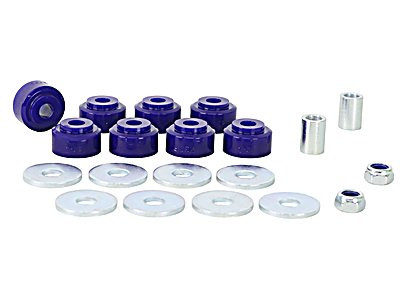
Bushing kits for one end or the whole car in one order.
The strut is the front shock absorber and the upper locating part of the corner. Its tube is clamped in a split collar at the top of the knuckle, the coil spring sits on a seat on the tube, and the sway bar link bolts to a tab on its side.
Signs of wear: Bouncing after bumps, nose dive under braking, oil on the tube, or a knock from the top of the strut over rough roads.
Tip: Complete strut assemblies come with the spring, mount and boot already fitted, so no spring compressor is needed.
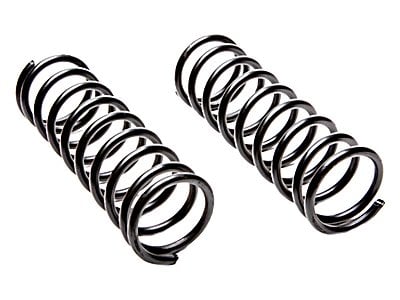
The front coil spring sits on the strut and pushes up against the top mount. It carries the weight of the front of the car.
Signs of wear: One front corner sitting lower than the other, a broken coil end, or a clunk when turning the wheel at a stop.
Tip: Replace springs in pairs so both sides sit at the same height.
The strut mount is the rubber and bearing block at the top of the strut. Its studs go up through the strut tower and its bearing lets the strut turn with the steering.
Signs of wear: Clunks or creaks from the top of the strut when steering at low speed, or steering that does not return to center.
Tip: Camber and caster plates replace the mount when the front alignment has to be corrected.
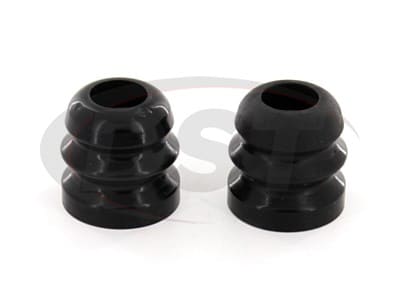
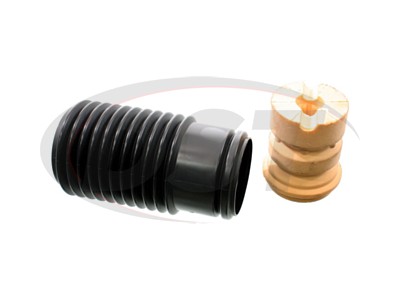
A rubber bellows covers the strut rod to keep grit off its seal, and the bump stop inside it cushions the strut at full compression. The spring hides it in the assembled view; the exploded view shows it.
Signs of wear: A torn or missing boot, a rusty or scored strut rod, or a hard bang over big bumps.
Tip: Fit a new boot and bump stop whenever the strut is replaced.
See all Front Shock Bellows Boot Kit parts for the 2002 Ford Focus
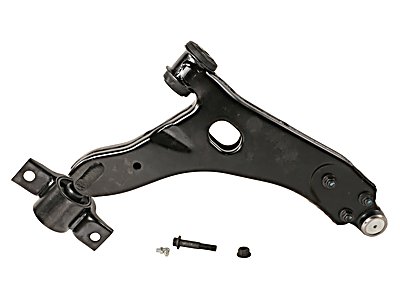
An L shaped stamped steel arm. The ball joint at its outer end carries the knuckle, a straight front leg pivots on a bushing at the front corner of the cradle, and the rear leg ends in a larger bushing held in a bracket that bolts up under the cradle.
Signs of wear: Clunks over bumps, steering that wanders under braking, cracked or torn bushings, or play in the ball joint.
Tip: Left and right arms are different parts. Replacement arms come with the ball joint and both bushings fitted.
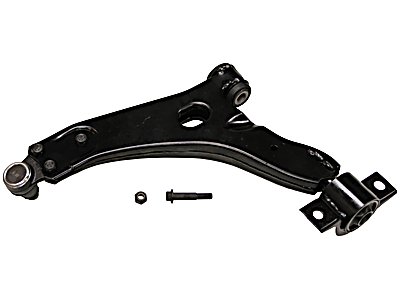
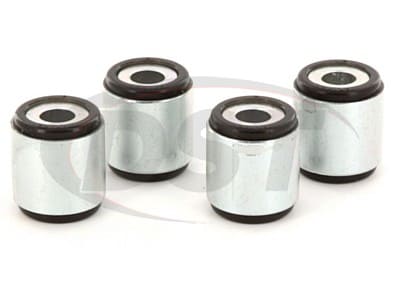
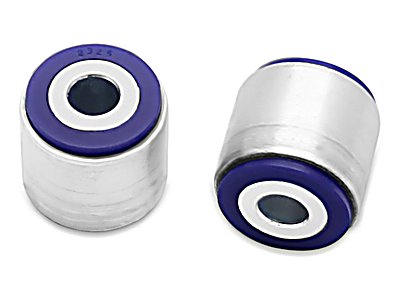
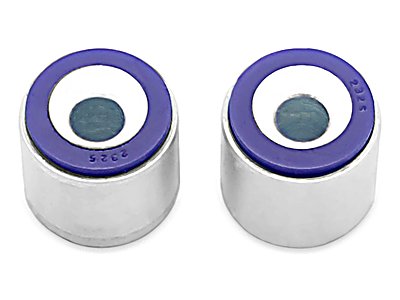
Each lower arm has two bushings: a small one in the front leg, on a bolt that runs front to back, and a larger one at the end of the rear leg, inside its bracket.
Signs of wear: Clunks when braking or pulling away, a vague steering feel, or rubber that is cracked or pushed out of place.
Tip: Front and rear bushings are different parts. Cars with the performance suspension use their own rear bushing.
See all Front Control Arm Bushings parts for the 2002 Ford Focus
The lower ball joint is held to the outer end of the lower arm, riveted at the factory and bolted on when it is replaced. Its stud points up into the bottom of the knuckle, where a pinch bolt clamps it.
Signs of wear: Clunks over bumps, a loose feel in the front end, or play when the wheel is rocked top to bottom.
Tip: A replacement joint comes with bolts to replace the factory rivets, which are drilled out.
See all Front Lower Ball Joint parts for the 2002 Ford Focus
The knuckle carries the wheel bearing and the brake caliper. The strut clamps into its top, the ball joint stud into its bottom, and its rear arm takes the outer tie rod end.
Signs of wear: Knuckles rarely wear out. A bent knuckle after a curb strike shows as a pull or a crooked steering wheel that an alignment will not fix.
Tip: Complete knuckle assemblies come with the bearing, hub and axle nut already fitted.
The front sway bar is mounted to the front cradle. Long links join its ends to tabs on the struts, so it twists when one side moves more than the other and keeps the car flatter in turns.
Signs of wear: Body roll in turns that feels worse than it used to, usually from worn links or bushings rather than the bar.
Tip: Bar diameters vary, so check the size before ordering bushings.
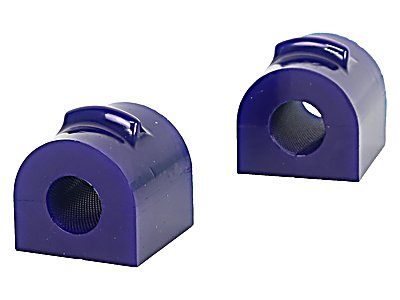
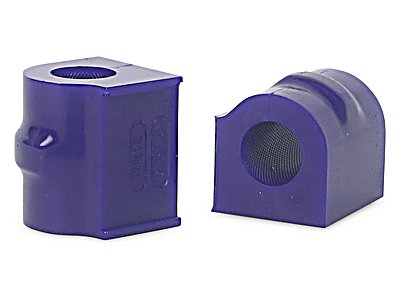
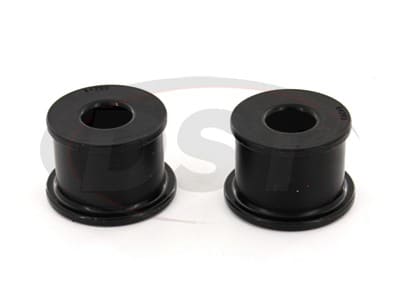
Two rubber bushings in steel clamps hold the front bar to the cradle.
Signs of wear: Squeaks or knocks from the front over speed bumps, or a bar that moves in its clamps.
Tip: Bushings fit one bar diameter only.
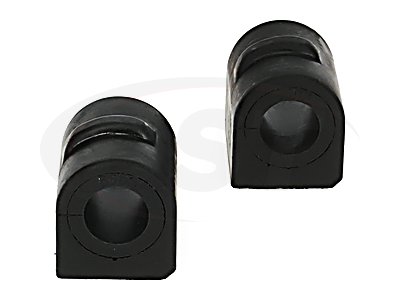
See all Front Sway Bar Bushings parts for the 2002 Ford Focus
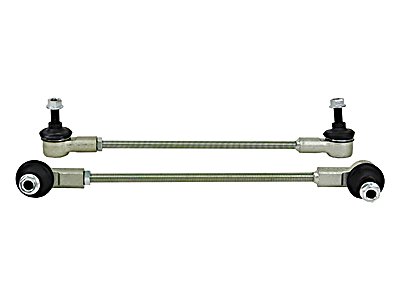
A long link, about 10.5 inches, with a ball stud at each end. The top bolts to a tab on the strut tube and the bottom to the end of the sway bar.
Signs of wear: A rattle or knock from the front over small bumps, or a link that moves by hand.
Tip: The same link fits both sides. Replace them in pairs.
See all Front Sway Bar Endlinks parts for the 2002 Ford Focus
The power steering rack sits behind the front axle on the rear of the cradle. Rubber boots at each end keep dirt off the inner tie rod joints.
Signs of wear: A torn boot, a clunk felt in the steering wheel, or a knock over bumps from the rack mounts.
Tip: Replace a torn boot quickly, before grit reaches the inner tie rod.
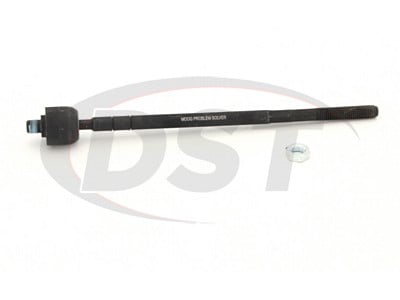
The inner tie rod screws onto the end of the rack inside the boot. Its ball joint lets the rod swing as the suspension moves.
Signs of wear: Play in the steering, a clunk when turning, or uneven tire wear.
Tip: Cars with variable assist steering use a different inner tie rod, so check before ordering. An alignment is needed after replacing a tie rod.
See all Front Inner Tie Rod End parts for the 2002 Ford Focus
The outer tie rod end threads onto the inner rod and is locked by a jam nut. Its stud goes up through the steering arm at the rear of the knuckle.
Signs of wear: Loose steering, a knock over bumps, a torn boot, or tires wearing on the edges.
Tip: Left and right ends are different parts. Count the turns when unscrewing the old one to keep the toe close until the alignment.
See all Front Outer Tie Rod End parts for the 2002 Ford Focus
Each front wheel is driven by a CV axle from the transaxle, with a plunging joint at the inner end, a fixed joint at the hub, and a rubber boot over each joint.
Signs of wear: Clicking while turning, a vibration under power, or grease thrown around the inside of the wheel from a split boot.
Tip: Axles differ for the automatic and the manual transmission, so check which one the car has.
See all CV Joint Parts - Front parts for the 2002 Ford Focus
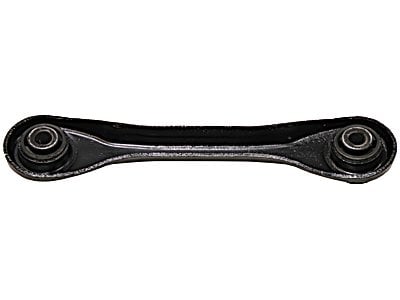
The rear knuckle and the trailing arm are one part. The knuckle carries the drum brake and the spindle, every rear link bolts to it, and its long arm runs forward to a bushing bolted to the body.
Signs of wear: The arm itself rarely wears out, but its front bushing and the links that hold it do.
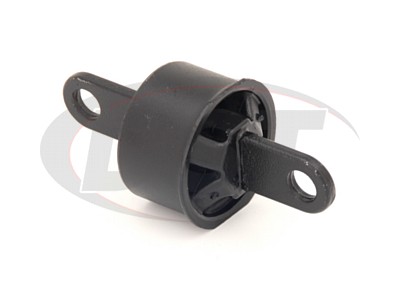
The bushing in the front end of the trailing arm. A plate runs through it and bolts up into a bracket on the body.
Signs of wear: A clunk on braking or a car that steps sideways over bumps.
Tip: The bushing is pressed out of the arm, so the arm comes off the car.
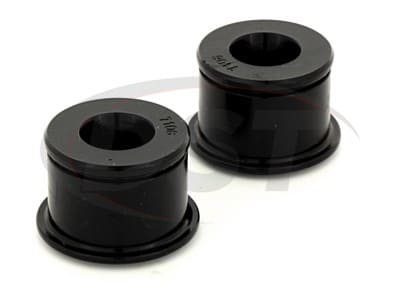
The wide lower arm behind the axle. Its inner end bolts to the rear cross member of the subframe, the coil spring sits in a pocket near its outer end, and its outer end bolts to the knuckle. On cars with a rear sway bar, the bar link bolts through it.
Signs of wear: A clunk from the rear over bumps, rust around the spring pocket, or a torn bushing.
Tip: Hold the spring with a jack before unbolting the arm from the knuckle.
The rear coil spring stands in the pocket of the spring arm and pushes up against the body. The shock is separate.
Signs of wear: A rear corner sitting low, or a broken coil end.
Tip: Replace springs in pairs.

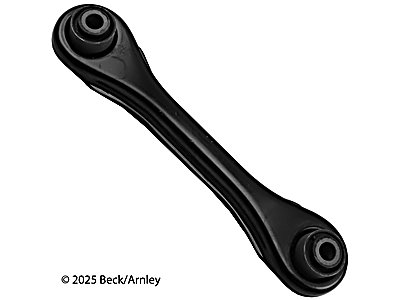
A short flat link ahead of the axle, from a bracket on the subframe's front cross member to the bottom front of the knuckle. It sets the rear toe.
Signs of wear: Rear tires wearing on the edges, or a knock from the rear on rough roads.
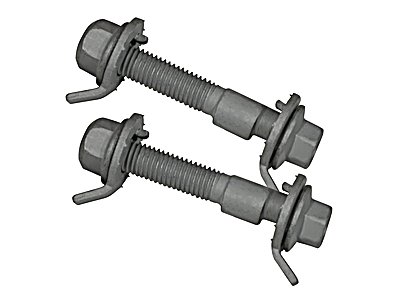
An eccentric cam bolt with two cam washers. Turning it moves a rear link in or out to set the rear toe.
Signs of wear: A cam bolt seized by rust, so the rear toe cannot be set.
Tip: Seized cam bolts often have to be cut out, so a new bolt kit is worth having on hand.
See all Rear End Alignment Kit parts for the 2002 Ford Focus
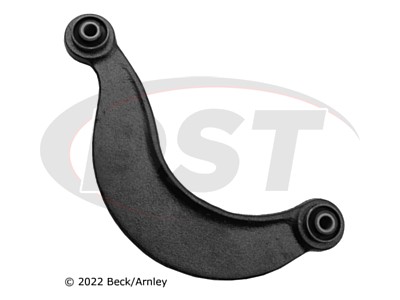
An arched arm above the axle line, from an upright on the subframe to the top of the knuckle. It sets the rear camber.
Signs of wear: A clunk from the rear, or rear tires wearing on the inner edge.
Tip: Adjustable arms are sold for lowered cars or to correct rear camber.
An eccentric bolt that replaces the bolt at the outer end of the rear upper arm. Turning it moves the top of the knuckle in or out by about one degree of camber.
Signs of wear: Rear tires wearing on the inner edge after a lowering kit or a bent part.
Tip: Fit it only where the camber needs correcting; the stock bolt has no adjustment.
See all Rear End Alignment Kit parts for the 2002 Ford Focus
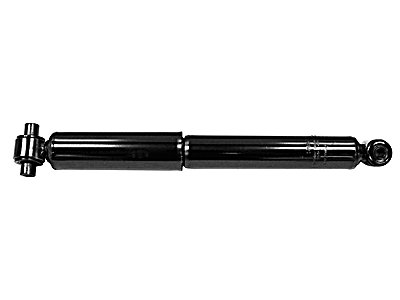
The rear shock is separate from the spring. Its lower eye bolts to the rear suspension and its stem goes up into the body, where it is held by a rubber mount.
Signs of wear: Bouncing or floating over bumps, oil on the body, or a rattle from the rear.
Tip: Replace shocks in pairs, and fit a new upper mount kit at the same time.
Where fitted, the rear sway bar is clamped to the rear subframe and joined to the rear lower arms by short bolt-through links.
Not on every vehicle: Fitted to cars with the performance package, not to every Focus. Check that your car has a rear bar before ordering.
Signs of wear: More body roll than usual, normally from worn links or bushings.
Tip: Cars with the performance package use a different rear bar, with smaller bushings.
Two rubber bushings in clamps hold the rear bar to the subframe.
Not on every vehicle: Fitted to cars with the performance package, not to every Focus. Check that your car has a rear bar before ordering.
Signs of wear: Squeaks or knocks from the rear over bumps.
Tip: Bushings come in two sizes, for cars with and without the performance package.
See all Rear Sway Bar Bushings parts for the 2002 Ford Focus
A bolt-through link: a long bolt with a pair of bushings on each side of the bar end and of the arm, and a spacer between them.
Not on every vehicle: Fitted to cars with the performance package, not to every Focus. Check that your car has a rear bar before ordering.
Signs of wear: A rattle from the rear over small bumps, or bushings that have split.
Tip: Replace both sides together.
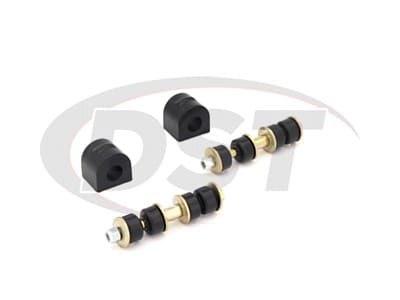
See all Rear Sway Bar Endlinks parts for the 2002 Ford Focus
The front bearing is pressed into the knuckle and held by a snap ring, and the hub is pressed into the bearing. The CV axle splines into the hub and is held by the axle nut.
Signs of wear: A hum or growl that changes with speed or when turning, or play when the wheel is rocked.
Tip: Replacing the bearing alone needs a press. A complete knuckle assembly avoids that.

See all Front Wheel Bearing and Hub Assembly parts for the 2002 Ford Focus
A vented 258 mm rotor clamped between the four stud hub and the wheel. 2005 to 2007 cars use a larger 278 mm rotor, so check the year.
Signs of wear: A pulsing brake pedal, grooves you can feel, or a lip at the outer edge.
Tip: Replace rotors in pairs and fit new pads with them.
A single piston floating caliper on a bracket bolted to the front of the knuckle.
Signs of wear: A pull to one side under braking, a dragging brake, or a fluid leak.
Tip: Left and right calipers are different parts.
The pads ride in the caliper on each side of the rotor. The inner pad carries a small metal wear tab that squeals when the pads are nearly worn out.
Signs of wear: Squealing, grinding, a longer pedal, or pads worn near the backing plate.
An 8 inch cast iron drum over the rear brake shoes. It turns on the bearing on the knuckle's spindle and carries the four wheel studs.
Signs of wear: A pulsing pedal when stopping gently, a scraping noise from the rear, or a drum worn past the size cast into it.
Tip: The drums listed here fit every 2000 to 2007 car with rear drum brakes.
Two shoes on a backing plate inside the drum, pushed out by a wheel cylinder at the top. The parking brake cable works them too.
Signs of wear: A weak parking brake, grinding from the rear, or a pedal that sinks lower than before.
Tip: Replace the shoes on both rear wheels together.
Front lower control arms and their bushings, front sway bar links, and tie rod ends are the parts most often replaced, followed by the rear lower arm bushings and the rear trailing arm bushings.
Both exist. Many cars have 8 inch rear drums, and our catalog lists rear rotors for cars with 4 stud wheels and a 253 mm rear rotor. The diagram shows drums. Check your rear brakes before ordering rear brake parts.
The Focus rear spring is chosen by body style. Check whether your car is a sedan, hatchback or wagon before ordering.
Yes, a separate bolt-on lower ball joint is listed for these cars, but the factory joint is held to the arm by rivets and the arm is also sold complete with the joint. Check your car's front arm and joint numbers in the catalog before ordering, because 2004 and later cars can have a newer arm.
Yes, after replacing tie rods, struts, control arms or rear links. Front toe is set at the tie rods and rear toe with the rear toe adjuster cam bolt. Cam bolts and adjustable arms are sold to correct rear camber.
Numbered diagrams to print or save for the shop. The numbers match the numbered parts on the interactive diagram.